
See the pipeline your GTM could be producing. Score my GTM in 3 minutes →
Clay Cup 2025🇬🇧 #1|🌍 Top 4 ClayCertified Specialists HubSpotSolutions Provider
Knowledge base

How we think about
revenue systems.

Reference guides on GTM engineering, data, scoring, signals and deliverability, from the team that builds owned revenue engines. Practical, opinionated, no fluff.

01

First-party data & ICP

Your data is either an asset or a liability. These guides cover how to turn first-party data into targeting advantage, build an ICP from evidence, and distinguish signal from noise.

Why first-party data is the only durable GTM moat If a competitor can buy the same signal, it isn't an advantage.

If a competitor can buy the same data feed with a credit card, it is not an advantage. Third-party enrichment, intent data, and AI writing tools are available to everyone. They raise the floor but differentiate nobody. The real edge is your own data: why your best customers actually bought, what your win/loss patterns reveal, and what product usage tells you about expansion or churn.

AI has made writing to the average free. Point it at a generic bought list and you get average output faster. Point it at your own closed-won patterns and competitors literally cannot reproduce the result.

  • Third-party intent data is useful for prioritisation but not defensible. Anyone can buy it.
  • The durable edge is your closed-won patterns, win/loss record, and product usage signals combined with public signals others are not assembling.
  • The test: could a competitor buy or rebuild this tomorrow? If yes, it is table stakes. If no, that is the advantage.
  • To make it work: interrogate your closed-won accounts for the real pattern, derive your ICP and scoring from that evidence, then engineer it into an automated system that compounds over time.
How to build an ICP from your closed-won data Your best customers already told you who to target.
Targeting by pain vs by persona Title tells you who might care; a signal tells you who cares today.
What counts as a buying signal (and what's noise) An observable, dated event that raises probability now.
02

Signals & data sources

The best outbound starts before the send. These guides cover how to find accounts with problems they haven't named yet, using public data and structural signals most teams overlook.

How to find accounts with a problem they can't see The strongest signal lives between two datasets.
The public data sources that reveal buying signals Companies House, FCA, filings, postings, registries.
How to turn a job posting into a sales signal A job spec is a public confession of a problem.
Build your list from buying conditions, not a database The list is an output of the system, not the input.
03

Scoring, routing & the funnel

Pipeline doesn't leak at one point. It leaks at every handoff, every delay, every unscored lead that got worked anyway. These guides decompose the funnel and show where the real problems hide.

How to clean up CRM data, and keep it clean Five steps. The first four are the cleanup everyone does; the fifth stops it drifting back.

Contact and company data decays at roughly 25% per year. A one-off cleanup looks good for about a quarter and then drifts straight back. The real fix is not the cleanup itself but the system that keeps it clean continuously, without relying on reps to do it.

  • Dedupe and merge: Reconcile duplicate companies and contacts into single records. This alone often reclaims double-counted pipeline.
  • Standardise fields: Normalise names, domains, job titles, geographies so filters and routing actually work.
  • Enrich the gaps: Fill missing data through multiple providers rather than relying on one source that misses a third of accounts.
  • Score against your ICP: Put a fit score on every record so reps spend time where it pays, not on an undifferentiated list.
  • Install the hygiene loop: Automate re-checks and re-enrichment on a schedule. Flag decay, reconcile new duplicates as they appear. This is the step that turns a cleanup into a CRM that stays clean with zero manual maintenance.
Read the full article
How to score leads by fit, intent and timing A transparent score beats a model nobody trusts.
Speed-to-lead: why conversion collapses by the hour Minutes, not days, decide the close.
Where your funnel actually leaks Decompose conversion step by step; the leak names itself.
How to route leads to the right rep Random assignment wastes lead quality and rep skill.
04

Outbound mechanics & deliverability

Outbound breaks in predictable ways. These guides cover the mechanics: deliverability, list quality, personalisation infrastructure, and why most teams are optimising the wrong layer.

How to fix cold email deliverability Below a 1% reply rate, something is broken. Here's the ladder.
How to measure list quality before you send A 5,000-row CSV is not a good list of 5,000.
Why your list is the real problem, not your copy You don't optimise copy when the input is wrong.
How to personalise at scale without sounding like a robot The unit of personalisation is the signal, not the token.
05

Measurement & AI

If you can't measure the engine, you can't improve it. These guides cover the metrics that actually predict revenue, the maturity curve for AI-built GTM, and why AI SDRs miss the point.

The AI-GTM maturity model Five levels, from manual averaged GTM to an owned engine that compounds.

Most teams think they are further along than they are. Usually level 0 or 1. The single jump that actually moves revenue is from level 2 to level 3. Adding more tools keeps you stuck; what matters is building from your own data and owning the system.

  • Level 0 — Manual: Bought lists, persona-based targeting, messages written to the average. AI now produces this for everyone, so it no longer differentiates.
  • Level 1 — Tools bought, not used: Clay, CRM, enrichment tools are paid for but sitting idle or half-configured. Spending is up but the motion has not changed.
  • Level 2 — Point automations, one person: Some workflows exist, built by one person. No coherent system, no measurement, breaks when that person leaves.
  • Level 3 — An owned engine: Enrichment, scoring, routing, and reporting engineered from your own closed-won data. Automated, measured, documented, and owned. This is where the number moves.
  • Level 4 — Compounding engine: The engine is tuned continuously, new plays ship regularly, manual admin is largely gone, and it compounds because it runs on data competitors cannot copy.
Read the full article
Positive reply rate: the only metric that matters Replies say attention; positive replies say demand.
The GTM metrics that tell you if your engine works Execution economics, not activity dashboards.
What is AI-built GTM? The engine is the asset; the data is the moat.
AI SDRs vs an owned revenue engine One scales sends, the other scales advantage.
06

Contrarian takes

The ideas that shape how we build. These aren't hot takes for the sake of it. Each one reflects something we've seen break in real revenue systems and the counter-intuitive fix that actually works.

Clay agency vs hiring a GTM engineer The honest version: cost, speed, risk and ownership, side by side.

An honest comparison between hiring a GTM/RevOps person in-house versus having an owned engine built for you. For most teams below a certain scale, the engine wins on cost, speed, risk, and ownership. A hire makes sense once you have enough volume to keep a full-timer busy, and even then, the right sequence is to build the engine first, then hire someone to operate it.

  • Cost: A senior hire fully loaded (salary, NI, tooling, contractors) runs £140-210k/year. An owned engine runs roughly £60-90k. About half.
  • Speed: A hire takes 3-6 months to recruit, onboard, and ramp. An engine goes live in weeks and produces pipeline immediately.
  • Risk: With a hire, the knowledge lives in one person's head. When they leave, you face a 3-6 month restart. An owned system is documented in code. Anyone can operate it. Zero key-person risk.
  • When to hire: Build the engine first and prove it works. Once volume justifies a dedicated head, hire someone to operate the proven system rather than building from scratch.
Read the full article
The handoff tax: why transitions destroy deal intelligence Every handoff is an information-destruction event.
Why your best reps don't follow the playbook The deviation is the signal.
Every process you built is already decaying The question is how you'll know before pipeline tells you.
Why CRM enforcement backfires Visibility beats compliance.
Skip the reading?

Stop reading, start measuring.

The Scorecard puts a pound figure on where your GTM leaks in 3 minutes. The applied version of everything on this page.
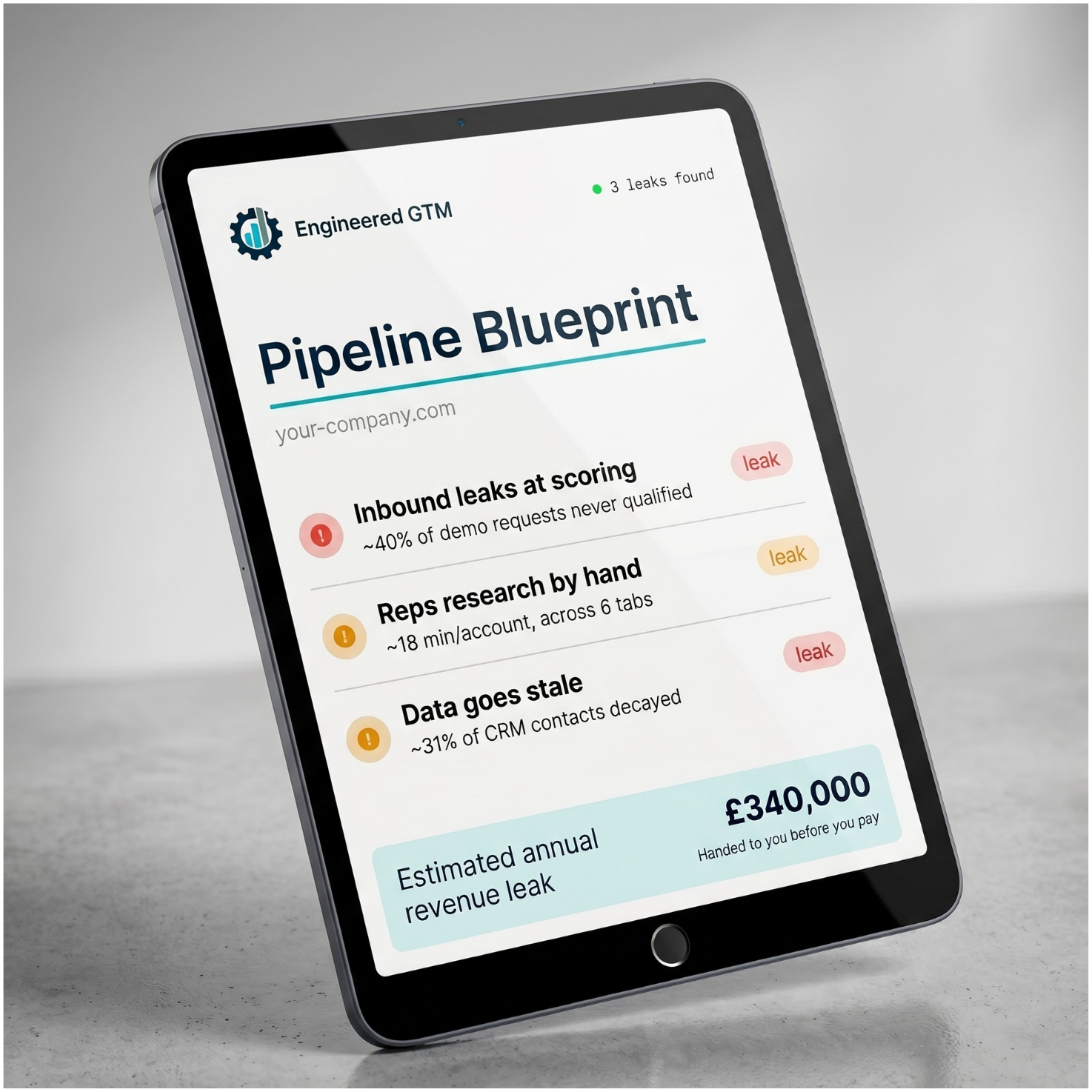
Score my GTM in 3 minutes → See the capabilities →
Pipeline Blueprint report showing 3 revenue leaks found